Intervention and management support in times of any form of crisis that can strike is important. Offering on the dot support through a team of dedicated and experienced resources is a key factor of containing the longer term consequences.
CCS operates a 24/7 availability of a response team able to intervene in line with the degree of emergency required. Our focus is on the human factor issues such a trauma containment, using debriefing and other group processes, offering individual support and working with the site management.
The critical incident management program is designed to prepare your organization establishing organizational preparedness and sufficient skill for site management to deal with arising emergencies as much as specific support at group and individual level handling exposure to trauma.
Generated as a psychological response to a deeply distressing or disturbing event it overwhelms an individual’s ability to cope, causes feelings of helplessness, diminishes their sense of self and their ability to feel a full range of emotions and experiences.
Triggers of trauma are difficult to categorise as reactions to unforeseen disturbing experiences are subjective and differ greatly from individual to individual. Still, circumstances typically involve the loss of control, betrayal, abuse of power, helplessness, pain, confusion and/or loss. Nonetheless, in trauma care the focus of professionals is mostly on the reaction to the situation and one’s perception about it, not the situation in itself, because of this deeply personal nature of the trauma.
(Graphical Card with symptoms of Trauma)
In its clinical form, trauma can generate Post Traumatic Stress Disorder. A psychologically impairing condition manifested through nightmares, mentally re-living the event, feelings’ suppression, altered anxiety state, changes in mood or thinking patterns, etc.
Due to this very psychologically intrusive and powerful nature of trauma, it can greatly impair the lives of affected individuals, sometimes up to the point of making them unfunctional at personal or professional level. This is the reason why many organisations seek support in being prepared and request professional interventions aimed at helping personnel to cope with potentially traumatic situations and their consequences. Such programs are generally known as ‘Critical Incident Stress Management’ or CISM.
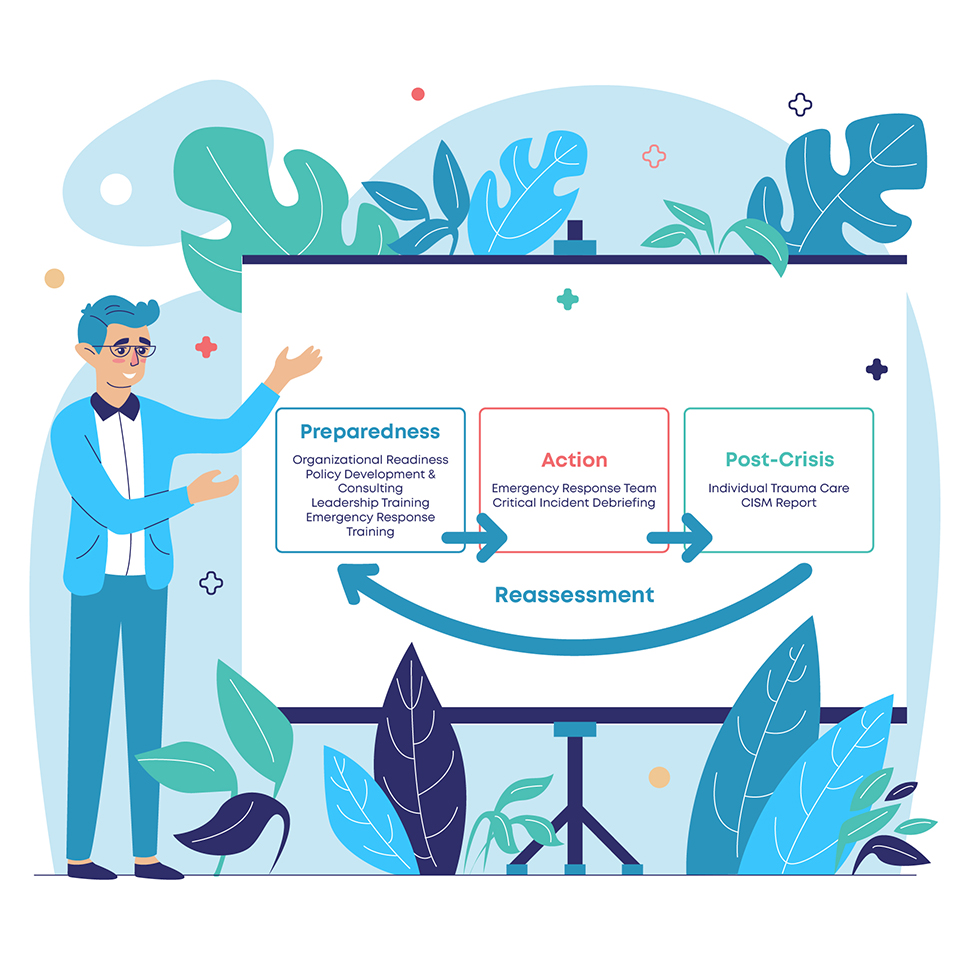
Critical incident stress management (CISM) is an adaptive, short-term psychological support process that focuses solely on an immediate and identifiable problem. It ranges from pre-incident preparedness to acute crisis management to post-crisis follow-up. Its purpose is to enable people to return to their daily routine more quickly and with less likelihood of experiencing post-traumatic stress reactions. In serious cases it can lead to clinical post-traumatic stress disorder (PTSD)
Experience has shown that site management is never prepared enough to get things right at once. Only continued awareness building and strategic simulation exercises develop the needed expertise.
The leadership skills needed to manage both the human and the organizational side of a crisis are quite different from those needed in day-to-day operations.
Planning and training are therefore essential in order to be truly able to handle an arising emergency situation and to coordinate a meaningful response.
The proper handling of a crisis will have positive effects on employee retention and loyalty. It can become a focal point of drawing employees together and to strengthen the corporate image and its CSR.
CCS has over 35 years of experience in aiding organisations developing their preparedness level to Critical Incidents and delivering professional on-site or remote interventions during the Action and Post-Crisis phases.